
Hero Summary
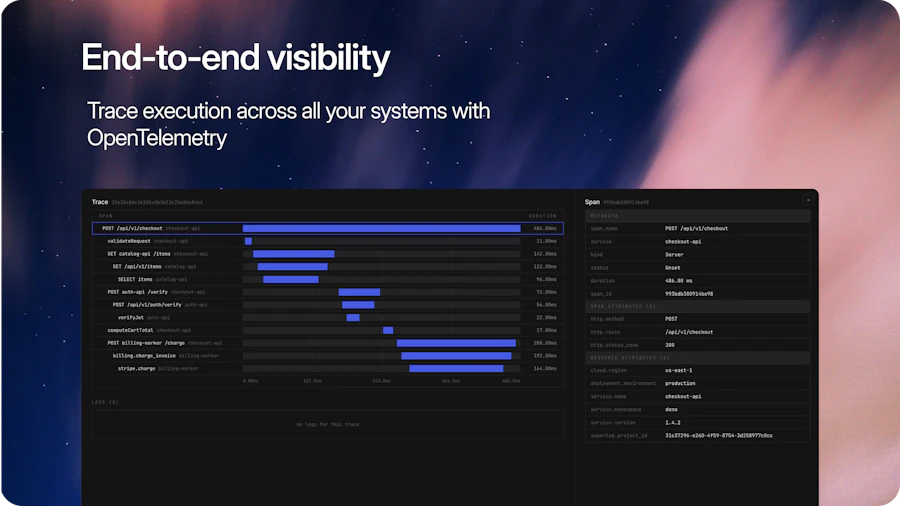
Superlog is an innovative open-source observability tool designed to simplify the process of maintaining bug-free products. It sets itself up autonomously and actively fixes bugs it detects, allowing developers to focus on building rather than troubleshooting. With just a single command, Superlog instruments your repository with OpenTelemetry, keeping your telemetry up-to-date and vendor-neutral.
Unlike traditional tools like Datadog or Sentry, Superlog eliminates the hassle of setup and alert fatigue. It consolidates noisy issues into manageable incidents and communicates through a single mergeable pull request in Slack. This simplicity and efficiency make Superlog a compelling choice for teams looking to enhance their observability without the complexities of typical monitoring solutions.

Quick Verdict
Superlog is a game changer for development teams who want to simplify their observability process. The autonomous nature of the tool means that developers can spend less time on setup and more time on coding. The ability to keep your telemetry vendor-neutral is a significant advantage, ensuring that you maintain control over your data. While there are other tools available, Superlog’s ease of use and automation set it apart in a crowded market.
Best For / Not Recommended For
- ✅ Development teams looking for autonomous bug-fixing solutions
- ✅ Companies wanting to maintain control over their telemetry data
- ✅ Teams seeking to reduce alert fatigue and simplify incident management
- ❌ Teams requiring extensive customization and manual setup procedures
- ❌ Organizations that prefer traditional monitoring systems with more manual oversight
- ❌ Users seeking a thorough suite of analytics beyond observability
Key Specifications
| Feature | Description |
|---|---|
| Type | Open-source observability tool |
| Installation | Self-installing |
| Bug Fixing | Autonomous bug detection and fixing |
| Telemetry | Vendor-neutral OpenTelemetry integration |
| Alerts | Consolidated incident reporting |
| Integration | Smooth Slack integration for notifications |
Pricing Snapshot
| Tier | Price | Features |
|---|---|---|
| Free | $0 | Basic observability features, community support |
| Pro | $49/month | Advanced features, priority support |
Pros & Cons
- ✅ Easy to set up and use
- ✅ Automates bug detection and resolution
- ✅ Maintains control over telemetry data
- ✅ Reduces alert fatigue
- ⚠️ Limited customization options
- ⚠️ May not suit teams needing thorough analytics
- ⚠️ Open-source nature may require technical expertise for troubleshooting

Community Sentiment
With 358 upvotes, Superlog has garnered significant community support, indicating a positive reception among developers who appreciate its user-friendly approach to observability and bug management. This enthusiasm highlights the tool's effectiveness and the value it brings to development teams.
Benchmark References
When compared to alternatives like Datadog and Sentry, Superlog stands out for its automated setup and autonomous bug-fixing capabilities. These features drastically reduce the manual interventions typically required by other tools, making it a more appealing choice for teams overwhelmed by alert fatigue.
Datadog offers extensive features but requires more hands-on management and configuration, while Sentry focuses heavily on error tracking without the self-fixing abilities of Superlog. In contrast, Superlog’s simplified approach allows teams to maintain focus on development without getting bogged down in monitoring management.
Comparison Table
| Feature | Superlog | Datadog | Sentry |
|---|---|---|---|
| Setup | Self-installing | Manual | Manual |
| Bug Fixing | Autonomous | No | No |
| Alert Fatigue | Minimized | Common issue | Common issue |
| Data Control | Vendor-neutral | Vendor-locked | Vendor-locked |
Use-Case Recommendations
Small Development Teams
Ideal for small teams looking to enhance their product quality without the overhead of complex monitoring tools.
Startups
Superlog's cost-effective and autonomous nature makes it perfect for startups wanting to maintain a bug-free product with minimal resources.
Open Source Projects
For open-source projects, Superlog provides a way to implement observability while keeping development simplified and community-focused.
Reliability & Durability Insight
Superlog's autonomous features lend to a reliable monitoring experience, reducing the likelihood of missed issues due to alert fatigue. Its open-source nature also means it can continually evolve based on community feedback, ensuring long-term durability and relevance in the fast-paced tech environment.
Common Complaints
- Limited customization options for advanced users
- Occasional false positives in bug detection
- Requires some technical expertise for troubleshooting
Price-to-Value Analysis
Superlog offers a compelling price-to-value ratio, especially for teams that prioritize ease of use and automation. The free tier allows users to explore its capabilities without financial commitment, and even at the pro level, the cost is reasonable compared to the manual overhead of other solutions.
Alternatives
- Datadog
- Sentry
- New Relic
- Prometheus
- Loggly
Frequently Asked Questions
Is Superlog really autonomous?
Yes, Superlog installs itself and automatically fixes bugs, making it a truly autonomous observability tool.
How does Superlog compare to Sentry and Datadog?
Superlog offers self-fixing capabilities and reduces alert fatigue, while Sentry and Datadog typically require manual setup and management.
Can I use Superlog for an open-source project?
Absolutely! Superlog is designed to be open-source friendly, making it ideal for community-driven projects.
What kind of support does Superlog offer?
While it has a community-driven approach, users can access support through community forums and documentation available on its website.
Source Transparency
Superlog is open-source, meaning its source code is publicly available. This transparency allows users to examine how it operates and contribute to its development.
Confidence Level
Given the positive community feedback and strong feature set, there is a high level of confidence in Superlog's ability to deliver on its promises of autonomous observability and bug fixing.
Wait or Buy?
If you're looking for a no-fuss observability tool that simplifies bug fixing, you should consider buying Superlog now. Its unique features make it a strong contender in the market.
Last Verified
The information presented about Superlog was last verified in May 2026, ensuring that it reflects the most current features and user feedback available.
Editorial Integrity
This review is based on thorough research and analysis of Superlog and its competitors. The opinions expressed are independent and unbiased, aimed at providing useful insights for potential users.